
Contents
-
-
Almond Milk
-
Coconut Milk
-
Hemp Milk
-
Cashew Milk
-
Oat Milk
-
Sesame Milk
-
Pumpkin Seed Milk
-
How Is Plant-Based Milk Produced Industrially?
Whether it’s rice, oat, or soy milk, commercially produced plant-based milk typically undergoes several processing steps. The production process generally follows a similar pattern:
- Grains, seeds, or legumes are ground and mixed with water.
- The mixture is heated and, in some cases, treated with enzymes.
- These enzymes break down starch into sugars, significantly increasing the milk’s natural sweetness.
- Additional ingredients, such as sunflower oil and sea salt, are often added.
What Does This Mean for Our Health?
This production process helps explain why many plant-based drinks taste so sweet, even when they are labeled “no added sugar.” Enzymatic breakdown can produce sugars from starch without requiring sugar to be added as a separate ingredient.
Here are some potential concerns:
- High Sugar Content: Enzymatic conversion can increase the amount of readily available sugars, potentially affecting blood sugar levels.
- Highly Processed: Heating and industrial processing can reduce the levels of certain heat-sensitive nutrients.
- Added Oils: Some plant-based drinks contain refined oils, such as sunflower oil. However, their presence does not automatically make a product inflammatory.
- Packaging: Beverage cartons such as Tetra Pak typically consist of multiple layers of cardboard, plastic, and sometimes aluminum, making recycling more complex.
The Simple Alternative: Make Your Own Plant-Based Milk
Making fresh, nutrient-rich plant-based milk at home is surprisingly easy. All you need are a few simple ingredients and a high-speed blender.
The Basic Method:
- Soak nuts or seeds (ideally overnight to improve digestibility and nutrient availability).
- Blend with fresh water.
- Optional: Add a date, vanilla, or cinnamon for extra flavor.
- Blend for 30–60 seconds – and you’re done!
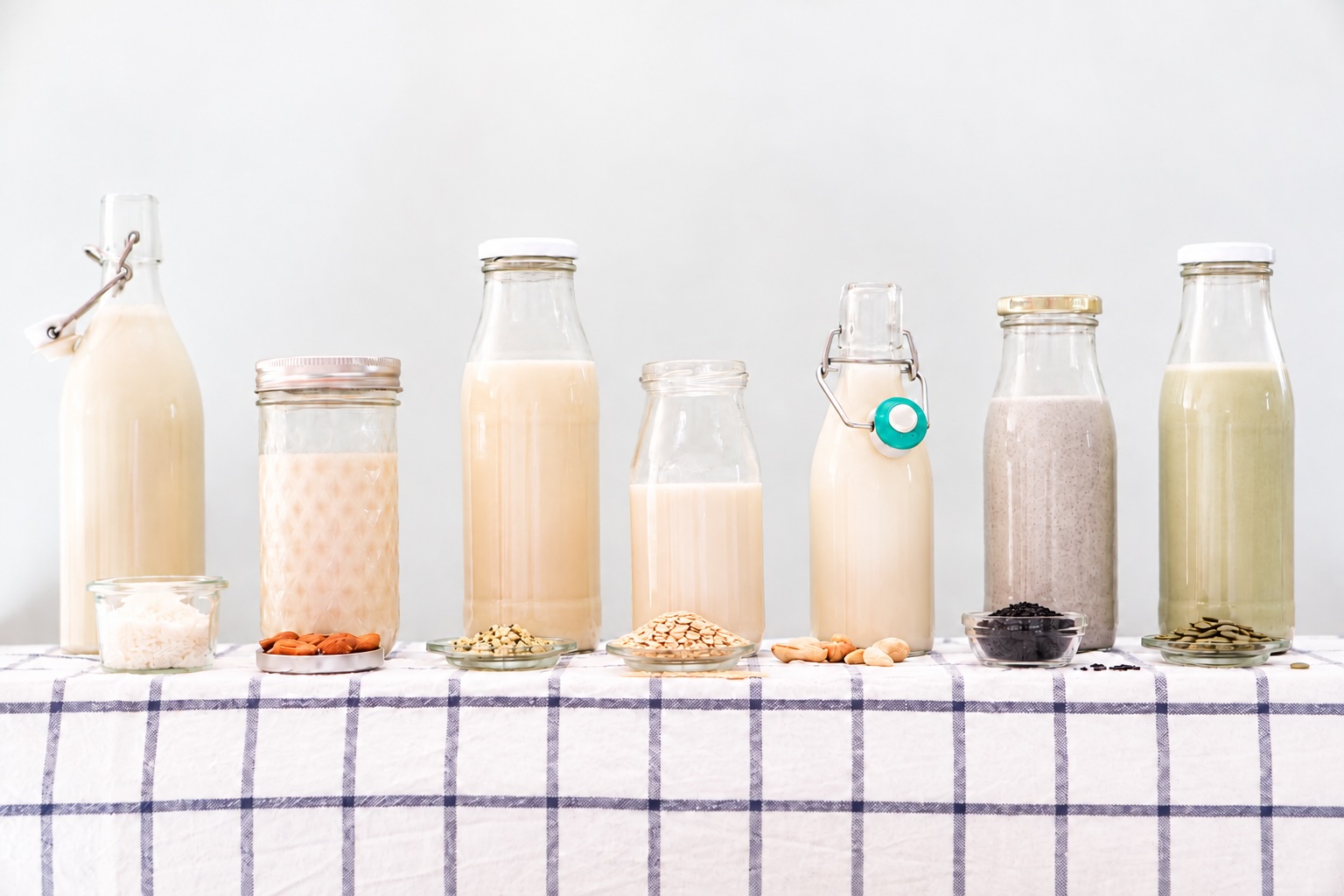
Plant-Based Milk Comparison
Below, we’ll show you simple, practical ways to make your own:
- Almond Milk
- Coconut Milk
- Hemp Milk
- Cashew Milk
- Oat Milk
- Sesame Milk
Each recipe makes approximately one liter of plant-based milk. For natural sweetness, we recommend dates, as they are considered alkaline-forming when metabolized.
ALMOND MILK
INGREDIENTS
Makes approximately 1 liter
- 150 g almonds
- 800 ml water
- 2 dates or a naturally sweetener of your choice
PREPARATION
- Soak the almonds in cold water for at least 8 hours, preferably overnight.
- The next morning, drain the soaking water, rinse the almonds thoroughly, and place them in a high-speed blender along with the dates (or honey) and fresh water.
- Blend on the highest setting for about 30 seconds.
- Pour the mixture through a nut milk bag and squeeze thoroughly with your hands to extract the milk.
Fresh almond milk keeps in the refrigerator for 2–3 days and tastes delicious on its own, with muesli, or as a base for smoothies.
COCONUT MILK
INGREDIENTS
Makes approximately 1 liter
- 100 g shredded coconut
- 800 ml water
- 2 dates or 1 tbsp honey
PREPARATION
- Grind the shredded coconut into a fine flour using a high-speed blender. Add the water and sweetener, then blend on the highest setting for 30 seconds.
- Pour the coconut milk through a nut milk bag and squeeze thoroughly to extract the liquid. (The leftover pulp can be dried and used in another recipe.)
- Pour the coconut milk back into the blender, add the sunflower lecithin, and blend briefly once more.
Fresh coconut milk keeps in the refrigerator for 2–3 days.
HEMP MILK
INGREDIENTS
Makes approximately 1 liter
- 50 g hulled hemp seeds
- 800 ml water
- 2 dates or a sweetener of your choice
PREPARATION
- Hemp milk is especially quick and easy to make: Hulled hemp seeds don’t need to be soaked, and the finished milk doesn’t need to be strained.
- Simply add the hemp seeds, dates, and water to a high-speed blender and blend on the highest setting for 30 seconds – and you’re done!
- The milk has a pleasantly nutty flavor and is rich in high-quality plant protein and essential fatty acids.
Tip: Hemp seeds naturally contain a favorable ratio of omega-6 to omega-3 fatty acids!
>> See also: “Healthier with Hemp Seeds”
CASHEW MILK
INGREDIENTS
Makes approximately 1 liter
- 150 g almonds
- 800 ml water
- 2 dates or 1 tbsp honey
PREPARATION
- Soak the almonds in cold water for at least 8 hours, preferably overnight.
- The next morning, drain the soaking water, rinse the almonds thoroughly, and place them in a high-speed blender along with the dates (or honey) and fresh water.
- Blend on the highest setting for about 30 seconds.
- Pour the mixture through a nut milk bag and squeeze thoroughly with your hands to extract the milk.
Fresh almond milk keeps in the refrigerator for 2–3 days and tastes delicious on its own, with muesli, or as a base for smoothies.

Tiger nuts are rich in dietary fiber
Their high content of soluble and insoluble dietary fibers is remarkable. Let’s take a closer look at the health effects of dietary fiber.
Soluble dietary fiber
Water-soluble dietary fibers such as pectin and inulin bind water in the large intestine and swell. In this way, they increase stool volume and stimulate intestinal motility.
In addition, water-soluble dietary fibers serve as food for intestinal bacteria and promote healthy intestinal flora. During metabolism, short-chain fatty acids are formed. Here, butyric acid (butyrate) in particular has become the focus of recent research. These short-chain fatty acids nourish the intestinal mucosa and stabilize its barrier function, strengthen immune defense, reduce inflammatory reactions in the body and play a role in regulating blood sugar levels.
Insoluble dietary fiber
Insoluble dietary fibers, like soluble dietary fibers, enter the large intestine intact. Here, also like soluble fiber, they bind water, contribute to an increase in stool volume and activate intestinal peristalsis.
With the preparation of tiger nut milk, we separate most of the dietary fiber as pomace in the nut milk bag. But this pomace doesn’t have to be discarded. We can dry it, grind it into flour and process it for further uses, for example in the Poppy Seed Apple Roll.
Would you like to join our unique, based on nutritional sciences and practice-oriented training program for gaining a high level of health?
We are more than happy to inform you about our training program on our website!


0 Comments